





Efficient aluminum can recycling requires more than collecting scrap metal. Recycling companies must also manage material storage, transportation expenses, and the efficient handling of loose aluminum cans.
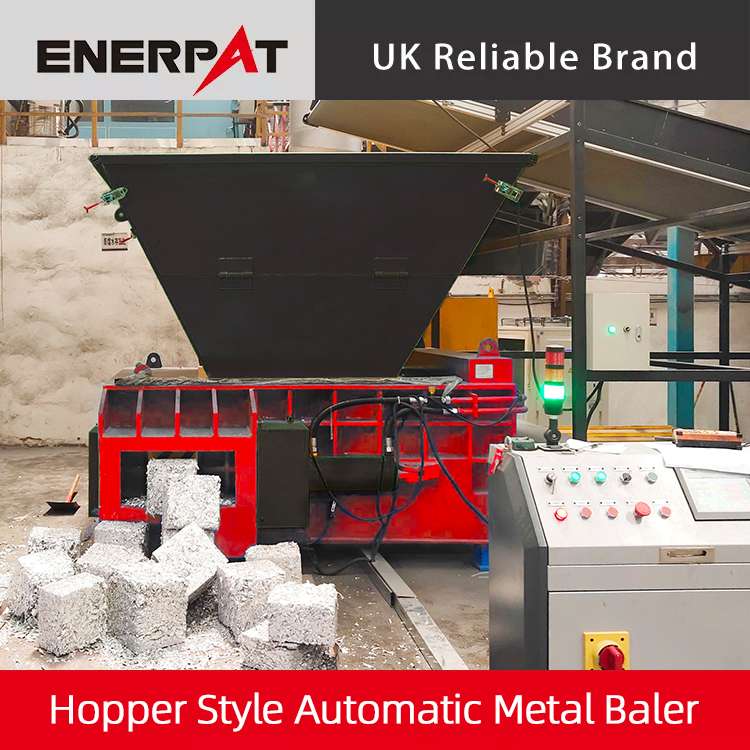
To address these challenges, a metal recycling company based in Santiago, Chile, adopted the ENERPAT AMB-H1510-160 Hopper Style Automatic Metal Baler to compress loose aluminum cans into compact, standardized metal bales.
The solution helps the customer optimize storage space, reduce the volume of material transported, and improve the efficiency of its aluminum recycling operations.
Loose aluminum cans occupy considerable space during storage and transportation. For recycling businesses handling large volumes of cans, this can create several operational challenges.
Loose aluminum cans have a relatively low bulk density. Transporting them without compression can mean using valuable truck space inefficiently.
By compressing loose cans into dense bales, recycling companies can optimize loading space and reduce transportation costs.
Uncompressed aluminum cans take up substantial space in recycling facilities. Effective compaction helps reduce the volume of stored materials and makes better use of available space.
Recycling operations benefit from standardized material preparation. Compact, uniform bales are easier to handle, store, transport, and deliver to downstream recycling facilities.
The customer therefore needed a reliable baling solution that could support efficient aluminum can processing while meeting its operational and economic requirements.
<IMAGE_PLACEHOLDER>
The ENERPAT AMB-H1510-160 is a hopper-style automatic metal baler designed to compress scrap metal into compact bales. In this Chilean project, the equipment was selected for aluminum can recycling, helping the customer streamline material handling and prepare scrap aluminum for transportation and further recycling.
| Parameter | Specification |
|---|---|
| Equipment Model | AMB-H1510-160 |
| Machine Type | Hopper Style Automatic Metal Baler |
| Application | Aluminum Can Recycling |
| Press Force | 160 tons |
| Motor Power | 30 + 30 hp |
| Operation Type | Automatic |
| Press Chamber | 59.06 × 39.37 inches |
| Bale Size | 11.81 × 11.81 inches |
These specifications are taken from the project case sheet. Actual equipment configuration should be confirmed according to the customer's material characteristics and production requirements.
The AMB-H1510-160 compresses loose aluminum cans into dense metal bales. Reducing the volume of scrap makes storage and material handling more manageable.
Compact bales allow recycling companies to use transportation space more efficiently than loose cans. This can help reduce logistics costs, depending on shipment volume, truck capacity, and transportation arrangements.
Standardized bales are easier to organize and move within a recycling facility. More efficient storage helps operators manage incoming materials and prepare processed aluminum for shipment.
After baling, the compressed aluminum scrap can be delivered to downstream recycling facilities for further processing. Efficient material preparation supports the recovery and reuse of valuable aluminum resources.
The customer selected the equipment based on its technical parameters and the availability of after-sales support. Stable operation and consistent bale quality are important considerations for recycling businesses seeking dependable production workflows.
The installation of the ENERPAT AMB-H1510-160 addresses the customer's primary requirement: compressing aluminum cans to reduce transportation costs.
The project offers several practical benefits.
Operational benefits: Automatic compaction simplifies aluminum can handling and produces standardized bales for storage and transportation.
Economic benefits: Reduced material volume can improve transport-space utilization and help control logistics expenses.
Environmental benefits: Organized scrap processing supports the efficient recovery and recycling of aluminum, helping keep recyclable materials within the resource recovery chain.
Resource recovery benefits: Densely baled aluminum scrap can be transferred to downstream recycling facilities for further processing and reuse.
Actual cost savings and productivity improvements depend on the volume of aluminum cans processed, operating hours, transportation costs, and downstream recycling arrangements.
Choosing a metal baler involves more than comparing press force or machine dimensions. Recycling businesses should also evaluate equipment configuration, material compatibility, operating requirements, and technical support.
ENERPAT provides metal recycling equipment designed for industrial scrap processing applications. The Chilean project demonstrates how a hopper-style automatic metal baler can be applied to aluminum can recycling, with a focus on material compaction, transportation efficiency, and reliable operation.
For businesses processing aluminum cans, aluminum scrap, and other suitable non-ferrous metal materials, selecting the correct baler starts with understanding the material, required bale dimensions, and target processing capacity.
If your business collects, processes, or recycles aluminum cans, an automatic metal baler may help reduce loose material volume, improve storage efficiency, and optimize transportation.
ENERPAT can help you evaluate a suitable metal baling solution based on your material type, processing capacity, available space, and operating requirements.
Contact ENERPAT to discuss your aluminum can recycling project and request a suitable equipment configuration.
Email: dove@enerpat.net
Tel: +86 13368546523
Website: ENERPAT Recycling Equipment | Industrial Shredders, Balers & Briquetters (enerpatrecycle.com)
ENERPAT — Metal Recycling Equipment for More Efficient Resource Recovery.
From Factory Testing to On-Site Installation: ENERPAT’s Commitment Goes Beyond Equipment D
READ FULLLos Angeles, California: ENERPAT Hopper-Style Automatic Metal Baler – Three Things Every B
READ FULLLocation: Las Vegas, Nevada, USAEquipment: ENERPAT Automa
READ FULL

Have a question or need a quote? Fill out this form and our team will get back to you quickly!