





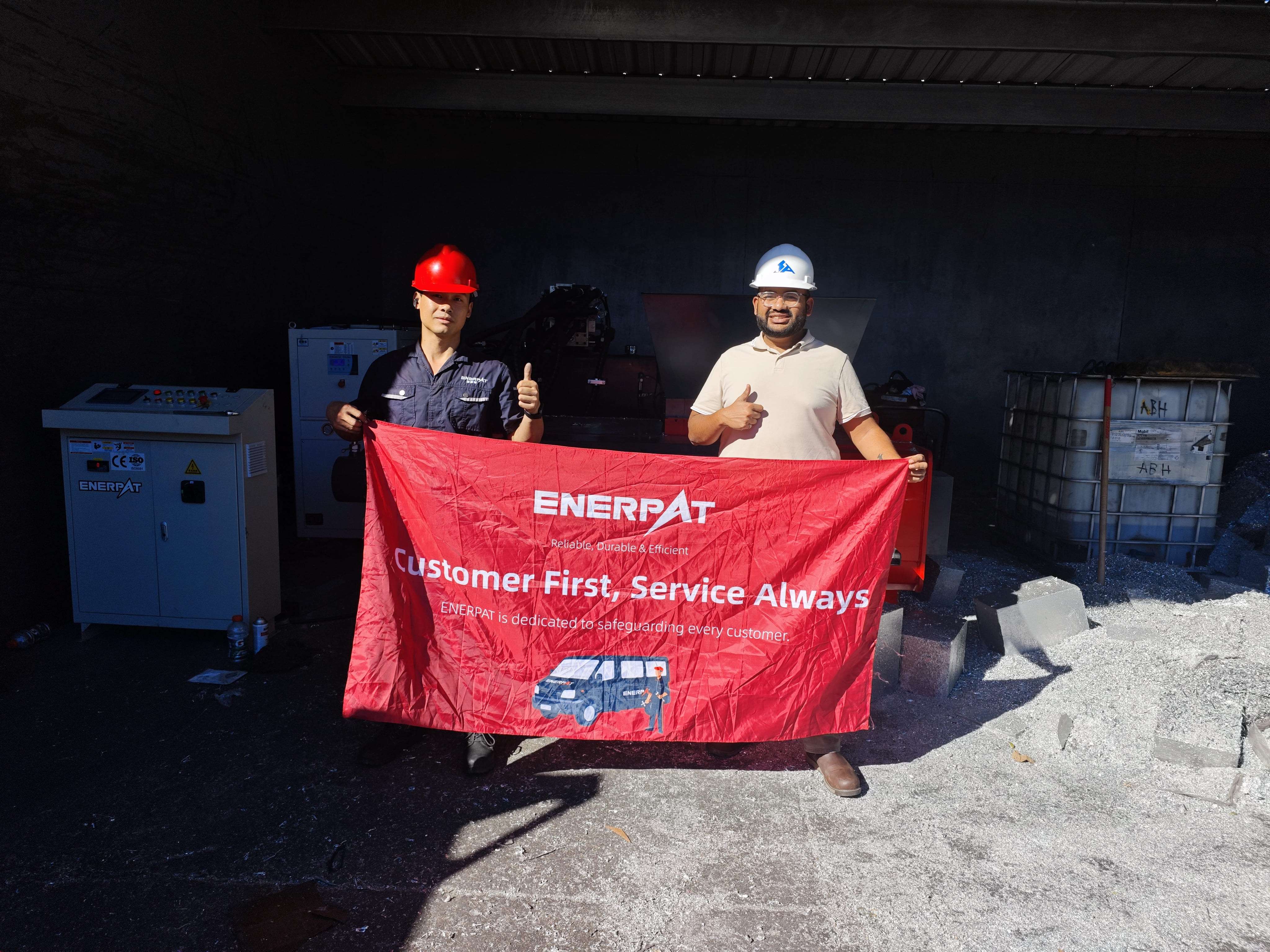
Project Location: Los Angeles County, California, USA
Equipment: ENERPAT Hopper-Style Automatic Metal Baler
Model: AMB-H1075-250
Application: Aluminum Chip Compaction
Industry: Metalworking and Metal Recycling
When a metalworking or recycling company invests in an industrial metal baler, the purchase decision involves much more than machine specifications.
Will the machine handle my materials properly? What happens if something goes wrong? And what if the machine does not perform as expected after delivery?
These are three questions every equipment buyer deserves a clear answer to.
In Los Angeles County, California, a metalworking company needed a practical way to compact aluminum chips before sending them for furnace processing. Loose aluminum chips occupied valuable storage space and made collection and material handling more complicated.
The company selected the ENERPAT AMB-H1075-250 Hopper-Style Automatic Metal Baler, a 250-ton hydraulic metal baling machine.
But beyond the machine itself, this project highlights three important considerations when choosing a metal baler supplier: reliable equipment, dependable technical support, and clearly defined purchase protection.
The answer starts with the material, the machine structure, and a properly matched configuration.
Aluminum chips are not always easy to handle. Depending on the machining process, they can be short, long, tangled, dry, or mixed with residual cutting fluids.
A machine that works well with one type of scrap may not deliver the same results with another.
For the Los Angeles County project, ENERPAT supplied the AMB-H1075-250 hydraulic scrap baling machine to compact suitable aluminum chips before furnace processing.
Unlike conventional equipment that relies on repeated manual loading and chamber closing, a hopper-style metal baler uses an open feeding hopper to receive loose scrap.
Depending on the installation configuration, material can be fed by conveyor, grapple, or overhead crane. The hydraulic system then compresses the material into compact metal bales.
For suitable applications, this design offers several practical advantages:
Continuous material feeding: The open hopper supports a more consistent feeding process.
Automatic hydraulic compression: Reduces dependence on repeated manual loading and pressing operations.
Compact metal bales: Makes loose scrap easier to collect, store, and transport.
Industrial construction: Designed for demanding metal recycling and manufacturing environments.
Flexible material applications: Suitable configurations are available for aluminum cans, metal turnings, aluminum chips, scrap wire, and other light metal scrap.
| Parameter | Specification |
|---|---|
| Machine model | AMB-H1075-250 |
| Equipment type | Hopper-Style Automatic Metal Baler |
| Rated pressing force | 250 metric tons |
| Motor power | 2 × 22 kW |
| Press chamber dimensions | 1,000 × 750 mm |
| Bale cross-section | 250 × 250 mm |
| Main application | Aluminum chip compaction |
The actual throughput, bale weight, and finished bale density depend on material characteristics and operating conditions. Representative material testing is recommended before finalizing the machine configuration.
For aluminum chips containing residual cutting fluids, additional de-oiling equipment may also need to be considered. A metal baler compresses material; it should not be treated as a substitute for a chip wringer or centrifuge when fluid removal is required.
Our promise: We want customers to select a machine based on their actual material and production requirements—not simply on a number in a brochure.
This is a serious concern for any American manufacturer or recycling company.
When a hydraulic metal baler stops operating, material can accumulate, production schedules may be affected, and the facility may need technical assistance quickly.
That is why after-sales support should be discussed before purchasing a machine.
For customers in the United States, ENERPAT provides a local contact and warehouse presence in the Los Angeles area.
ENERPAT USA Contact Information
Warehouse: 3959 E Guasti Rd Ste C, Los Angeles, CA 91761, United States
Telephone: +1 (909) 996-3687
Email: info@enerpatrecycling.com
Having a local warehouse and a US contact channel gives customers a practical starting point when they need to discuss equipment availability, spare parts, or technical support.
A clear support process should cover several steps:
Step 1 – Report the problem
The customer contacts the ENERPAT support team and provides the machine model, operating conditions, alarm information, and a description of the problem.
Step 2 – Technical troubleshooting
The technical team reviews the information and helps identify possible causes. Photos, videos, and operating records can make diagnosis more efficient.
Step 3 – Parts and repair arrangements
If replacement parts or further repair work are required, the necessary arrangements should be confirmed with the service team.
Step 4 – Follow-up and operation guidance
After the issue has been addressed, the customer should receive appropriate guidance on operating checks and preventive maintenance.
The actual response method, parts availability, service costs, and whether an on-site visit is required should be confirmed according to the customer's service agreement.
Our promise: Customers should know exactly whom to contact and how technical problems will be handled before the equipment arrives.
This is a question that deserves an honest answer.
An industrial metal baler is not a standard consumer product. Its return conditions depend on the purchase contract, equipment condition, manufacturing status, acceptance criteria, and the reason for the return request.
That does not mean customers should purchase equipment without protection.
Before ordering an automatic metal baler, we recommend confirming the following points in writing:
Material suitability: Confirm the actual type, size, shape, and condition of the scrap to be processed.
Machine configuration: Specify the required pressing force, chamber dimensions, bale size, feeding arrangement, and electrical requirements.
Performance expectations: Define the expected processing rate and acceptance conditions based on representative material testing.
Warranty responsibilities: Clarify warranty coverage, exclusions, and the process for reporting equipment faults.
Return and dispute terms: Agree on the conditions, responsibilities, and procedures for returns, repairs, replacements, or other remedies if the machine fails to meet the contractual requirements.
For the Los Angeles aluminum chip application, material testing was an important part of the equipment selection process. It helped establish whether the proposed machine configuration was appropriate for the customer's actual aluminum chips.
Our promise: Important purchasing conditions should be discussed and documented before the customer places an order. No unclear verbal promises and no assumptions about unconditional returns.
The Los Angeles County project demonstrates the application of the ENERPAT AMB-H1075-250 hopper-style automatic metal baler in aluminum chip compaction.
For metalworking companies, aluminum machining chips are valuable recyclable materials. However, their loose form can create storage and handling challenges before they reach the next processing stage.
A properly selected aluminum chip compactor helps organize this material into compact bales, supporting more manageable storage and transportation.
For American buyers, the purchasing decision should consider three things together:
Equipment quality: Is the machine suitable for my material and production requirements?
After-sales support: Do I have a clear technical support contact if something goes wrong?
Purchase protection: Are warranty, acceptance, and return conditions clearly written into the contract?
A good industrial equipment supplier should be prepared to discuss all three.
ENERPAT manufactures hydraulic metal balers and industrial recycling equipment for metalworking plants, scrap yards, aluminum recycling facilities, and non-ferrous metal processors.
Our hopper-style automatic metal baler range is designed for suitable lightweight scrap materials, including:
Aluminum chips and aluminum turnings
Used beverage cans (UBC)
Aluminum cans and scrap aluminum
Light metal scrap
Scrap wire and suitable tire wire
Aluminum extrusion offcuts
Other suitable non-ferrous metal scrap
Whether you need an aluminum chip compactor, an automatic scrap metal baler, or a continuous-feed hydraulic metal baling machine, ENERPAT can help evaluate your material and discuss a suitable configuration.
Three questions. Clear answers. One better-informed equipment decision.
Contact ENERPAT to discuss your metal scrap, required capacity, bale dimensions, and project requirements.
ENERPAT – Your Partner in Industrial Metal Recycling Equipment.
Website: https://www.enerpatrecycling.com/
Los Angeles, California: ENERPAT Hopper-Style Automatic Metal Baler – Three Things Every B
READ FULLLocation: Las Vegas, Nevada, USAEquipment: ENERPAT Automa
READ FULLNew Jersey, USA: ENERPAT Fully Automatic Horizontal Baler Helps Streamline Cardboard Recycling O
READ FULL

Have a question or need a quote? Fill out this form and our team will get back to you quickly!