





For recycling facilities, distribution centers, manufacturing plants, and waste management companies, handling large volumes of recyclable materials can be challenging. Loose cardboard, waste paper, plastic films, and other industrial recyclables often take up valuable storage space and require considerable labor to collect, compress, and prepare for transportation.
An auto tie horizontal hydraulic baler offers a more efficient solution by combining continuous material feeding, hydraulic compression, automatic wire tying, and bale discharge into one integrated system.
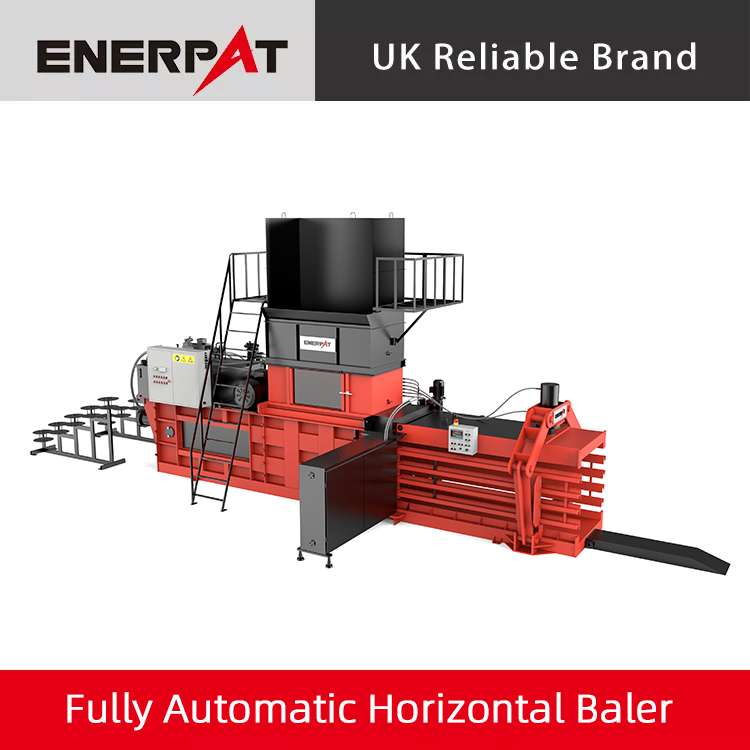
The ENERPAT Auto Tie Horizontal Hydraulic Baler is designed to help businesses improve material handling, produce compact and manageable bales, and optimize their recycling operations. For facilities processing large quantities of recyclable waste every day, investing in an automatic horizontal baling machine can be an important step toward a more streamlined production process.
An auto tie horizontal hydraulic baler is an industrial machine that compresses loose recyclable materials into compact bales and automatically secures them with wire.
Unlike conventional balers that require operators to manually tie completed bales, an automatic tying system performs the tying process with less manual intervention. Combined with continuous feeding and hydraulic compression, it helps maintain a more consistent workflow in high-volume recycling environments.
The ENERPAT HBA Series is designed for applications requiring efficient waste processing, consistent bale formation, and automated material handling.
Key features include:
Automatic Wire Tying: Finished bales are automatically tied to help maintain their shape during storage and transportation.
Hydraulic Compression: Hydraulic force compresses loose materials into compact bales.
Continuous Feeding: A suitable feeding system helps maintain material flow during operation.
Multiple Bale Sizes: Different models are available to accommodate varying material handling and bale requirements.
Integrated System Options: Conveyors and other auxiliary equipment can be configured according to the facility's needs.
These features make the ENERPAT automatic horizontal baler a practical choice for businesses looking to improve their recycling workflow.
The ENERPAT Auto Tie Horizontal Hydraulic Baler integrates several stages into a coordinated baling process.
Cardboard, waste paper, plastic films, bottles, and other suitable recyclable materials are introduced into the feeding system. Depending on the application, a conveyor can be integrated to support continuous material delivery.
The feeding mechanism transfers the material toward the baling chamber, helping maintain a steady flow and reducing the need for repeated manual loading.
The hydraulic ram pushes the material into the compression chamber, gradually forming a dense bale. The final bale characteristics depend on the material, machine configuration, and operating conditions.
When the bale reaches its preset length, the automatic wire-tying mechanism secures it. This reduces the amount of manual work required for bale tying and helps standardize the process.
The completed bale is discharged for storage, transportation, or further processing. The finished bales are easier to handle and organize than loose recyclable materials.
By integrating these stages, an automatic horizontal hydraulic baler helps create a more efficient path from loose waste to transport-ready bales.
A versatile horizontal baling machine can support different recycling and waste management applications, depending on its configuration.
Commonly handled materials include:
Cardboard and Waste Paper
Retailers, warehouses, packaging companies, and paper recycling facilities generate substantial quantities of cardboard and waste paper. Baling these materials helps consolidate loose waste and simplify collection, storage, and transportation.
Plastic Films and Plastic Bottles
Plastic films, shrink wrap, PET bottles, and other suitable plastic recyclables can be compressed into manageable bales for downstream recycling.
Industrial and Commercial Waste
Manufacturers and commercial facilities often generate packaging waste and other suitable compressible materials. An automatic baler can be incorporated into their waste management systems to improve material organization.
Other Suitable Recyclables
Depending on the material characteristics and required bale specifications, the equipment may be configured for additional compatible waste streams.
Before selecting a machine, businesses should confirm material suitability, required bale density, and expected throughput with the equipment supplier.
Manual tying can become a production bottleneck when a facility processes large quantities of waste. Automatic wire tying reduces operator involvement in this stage and supports a more consistent workflow.
Continuous feeding, hydraulic compression, and automatic tying work together to simplify the baling process. This can help reduce interruptions associated with repeated manual handling.
Loose cardboard, paper, and plastic waste can occupy considerable floor space. Compressing these materials into compact bales helps facilities organize their storage areas more efficiently.
Compact, securely tied bales are generally easier to stack, move, and prepare for shipment than loose materials. This can make internal handling and outbound logistics more manageable.
The ENERPAT HBA Series includes model options with different compression forces and bale dimensions. Selected configurations can achieve throughput of up to 20 tons per hour, depending on the material and operating conditions.
For businesses handling substantial daily waste volumes, choosing the appropriate automatic baler can help establish a more efficient and scalable recycling process.
When choosing a baling machine, the right option depends on material volume, labor availability, operating requirements, and budget.
A manual or semi-automatic baler may be suitable for smaller operations with lower daily throughput. However, as material volumes increase, manual handling and bale tying can place additional demands on operators.
An automatic horizontal baler is designed to integrate feeding, compression, automatic tying, and bale discharge into a more continuous process.
For high-volume recycling plants, distribution centers, and manufacturing facilities, this integrated approach can help reduce dependence on manual bale handling and improve overall workflow consistency.
The goal is not simply to compress more material. It is to build a baling process that fits the facility's actual production requirements.
Selecting the right machine requires more than comparing hydraulic pressing force or motor power.
Before investing in an automatic horizontal baler, consider the following factors:
Material Type: Cardboard, paper, plastic film, and bottles have different compression characteristics.
Daily Processing Volume: Estimate how many tons of material your facility needs to process per hour or per day.
Required Bale Size and Weight: Bale dimensions should meet your storage, handling, and transportation requirements.
Feeding Method: Determine whether manual loading is sufficient or whether a conveyor-based feeding system would better support your operation.
Available Installation Space: Consider the machine footprint, conveyor layout, maintenance access, and bale discharge area.
System Integration: Evaluate whether the baler needs to connect with existing sorting, conveying, or material handling equipment.
The ENERPAT team can help assess these factors and recommend a suitable HBA Series configuration based on your material, throughput, and site requirements.
ENERPAT provides industrial recycling equipment designed for a range of waste processing and material recovery applications.
The Auto Tie Horizontal Hydraulic Baler combines hydraulic compression, automatic wire tying, and configurable material feeding in one integrated system. It is designed for recycling facilities and industrial operators seeking a practical solution for high-volume recyclable waste.
Depending on the selected model and project requirements, ENERPAT can also support integrated baling systems incorporating feeding conveyors, hoppers, bale discharge systems, and other auxiliary equipment.
For eligible HBA models, ENERPAT offers U.S. stock availability and local service support through its Ohio facility and North American service team. Support may include installation, commissioning, operator training, and after-sales technical assistance.
By matching the equipment configuration to the material and production requirements, businesses can make more informed decisions about their long-term recycling operations.
An auto tie horizontal baler is an industrial machine that compresses recyclable materials into compact bales and automatically ties them with wire, reducing the need for manual bale tying.
Common applications include cardboard, waste paper, plastic films, PET bottles, and other suitable recyclable materials. Final material compatibility depends on the machine configuration and material characteristics.
Throughput varies by model, material type, bulk density, feeding conditions, and operating settings. Selected ENERPAT configurations are rated for up to 20 tons per hour. Consult ENERPAT for an application-specific recommendation.
Yes. It can be suitable for recycling plants, material recovery facilities, warehouses, distribution centers, and manufacturing operations that process substantial quantities of compressible recyclable waste.
Start by identifying your material type, daily processing volume, desired bale dimensions and weight, feeding method, and available floor space. These details help determine the appropriate model and system configuration.
Efficient waste management requires more than collecting recyclable materials. Businesses must also compress, secure, store, and transport those materials effectively.
The ENERPAT Auto Tie Horizontal Hydraulic Baler combines continuous feeding, hydraulic compression, and automatic wire tying to help streamline these tasks. With different model configurations and options for integrated material handling, it can support the needs of a wide range of recycling and industrial waste operations.
Whether you process cardboard, waste paper, plastic films, or other suitable recyclables, selecting the right automatic baling system can help you improve material handling and make better use of your facility's space.
Looking for an automatic horizontal baler for your recycling facility?
Contact ENERPAT to discuss your material type, processing capacity, bale requirements, and installation conditions. Our team can help you identify a suitable Auto Tie Horizontal Hydraulic Baler for your application.
ENERPAT — Reliable, Durable & Efficient Recycling Equipment.
Auto Tie Horizontal Hydraulic Baler: A Smarter Solution for High-Volume Waste Recycling
READ FULL

Have a question or need a quote? Fill out this form and our team will get back to you quickly!