






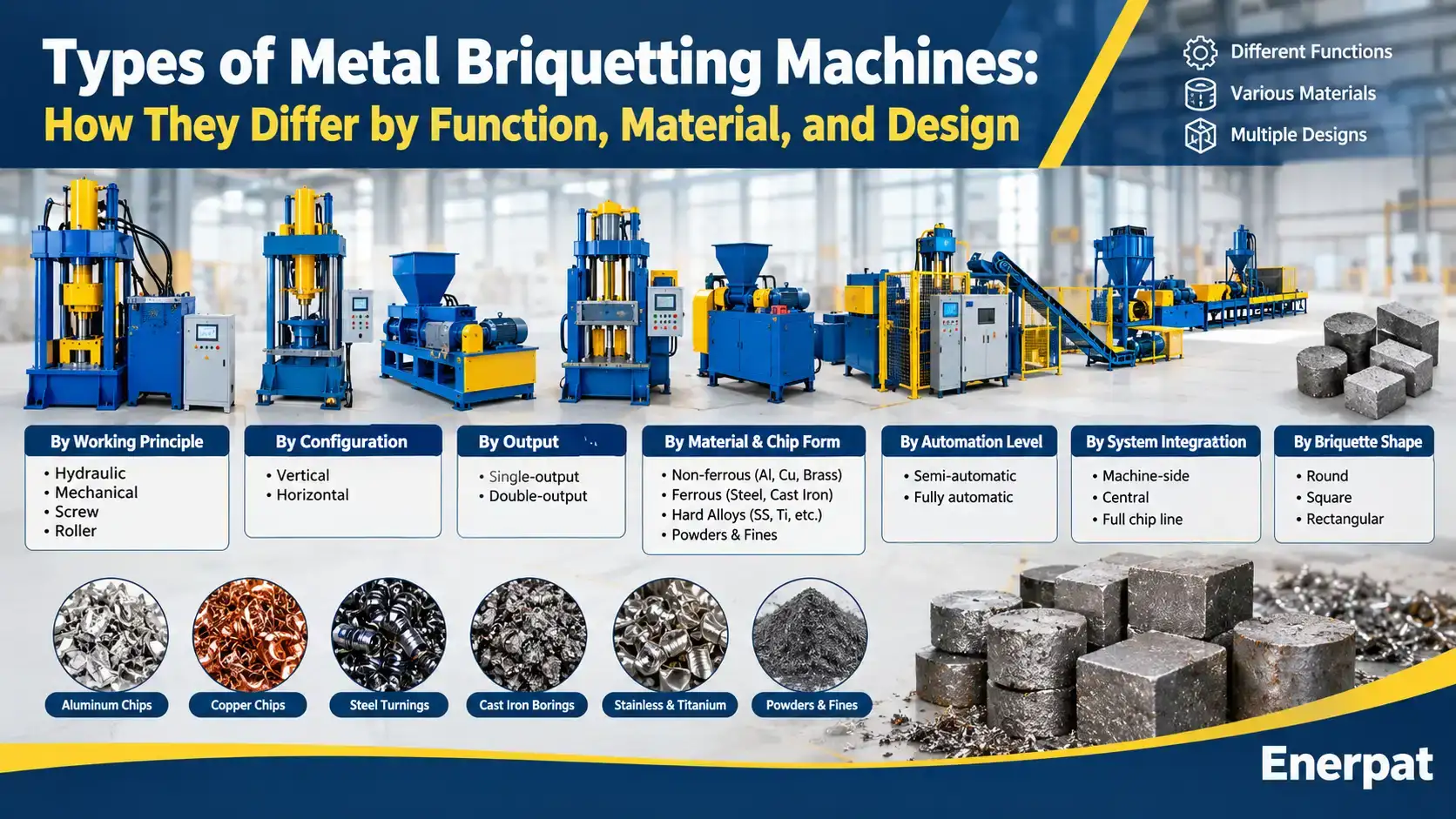
Machine shops, foundries, and metal recyclers all use a briquetting machine to turn loose chips, swarf, and powder into dense, solid briquettes, yet no two plants need the same machine. Briquetting machines divide into types along several lines: how they generate force, how they are laid out, how many briquettes they press per cycle, which metals they handle, how automated they are, and how they connect to the rest of the shop.
This guide covers each of those lines in turn and explains what every type does well, where it struggles, and which operation it suits. A summary table comes first, followed by the working principles, the vertical and horizontal layouts, single and double output, metal-specific needs, automation levels, system integration, and briquette shape. A selection table and a set of buyer questions close the guide, so you can match a type to your own chips before you ask for a quotation.
A metal briquetting machine compresses loose metal waste, such as chips, turnings, swarf, filings, and powder, into a dense block called a briquette, puck, or cake. Suppliers also call it a briquetter, a briquetting press, a chip briquetter, or a puck machine. Inside, a ram drives the material into a pressing chamber and a die, and the metal particles lock together under pressure without any binder.
The type of machine matters because metal chips behave very differently from one operation to the next. Soft aluminum chips are light and bulky, steel turnings are long and springy, cast iron borings are short and abrasive, and fine powder packs into tight chambers. A press that suits one stream can jam, wear out quickly, or sit idle on another. The table below summarizes the main ways to classify briquetting machines and the buying decision each one answers.
| Classification | Main types | Decision it answers |
|---|---|---|
| Working principle | Hydraulic, mechanical, screw, roller | Which force system suits metal chips |
| Configuration | Vertical, horizontal | How much floor space, volume, and fluid handling you need |
| Output | Single-output, double-output | How many briquettes one machine presses per cycle |
| Metal and chip form | Soft non-ferrous, steel, cast iron, hard alloys, powders | How much force, feed control, and wear resistance you need |
| Automation | Semi-automatic, fully automatic | How much labor each cycle requires |
| System integration | Machine-side, central, full chip line | Where the press sits and what feeds it |
| Briquette shape | Round, square, rectangular | What your furnace or scrap buyer accepts |
A briquetting machine and a scrap metal baler both compress scrap, but they handle different material. A baler compresses large, bulky pieces such as sheet metal, drums, cans, and structural scrap into bales, and it does not recover cutting fluid. A briquetting machine compresses small loose particles and squeezes the fluid out of them. A plant with both bulky scrap and machining chips often runs one of each.
The working principle describes how the machine generates the force that forms the briquette. Four principles appear in the briquetting industry, but only one of them dominates metal chip work.
A hydraulic briquetting machine uses a pump, valves, and cylinders to drive the ram. Operators can adjust the pressure and hold it at its peak for a set dwell time, and that pause lets the metal deform permanently and offsets the spring-back that loose chips show after compression. This control makes hydraulic machines the standard choice for metal chips, because they handle oily, wet, and mixed material and squeeze out the cutting fluid during the stroke. They run quieter than mechanical presses, although each cycle takes longer.
A mechanical briquetting machine uses a motor to spin a flywheel, and a crank or eccentric mechanism turns that rotation into rapid punch strokes. Some suppliers call this design a stamping or punching press. The cycle runs fast, but the pressure profile stays fixed or limited, and the dwell at peak pressure is short. Mechanical machines therefore suit dry, uniform feed better than oily or mixed chips. They run louder and carry a heavier frame, and sources disagree about which type yields the denser briquette, so buyers should test their own chips on either design.
A screw briquetting machine, also called an auger press, pushes material through a heated die with a rotating screw. This design serves sawdust, wood waste, and other biomass, and it relies on heat or a natural binder in the material to hold the briquette together. Metal chips do not bond that way, so screw machines do not suit metal chip briquetting.
A roller briquetting machine passes fine material between two counter-rotating rollers that carry pockets in their surface, and each pocket shapes a pillow or egg-shaped briquette. Plants use this design for coal, minerals, and fine powders, including dust and mill scale in steel mills. Roller machines serve those fine, free-flowing materials, and they do not replace a press for machining chips.
Configuration describes the direction in which the main ram moves. Both layouts use hydraulic force, and both produce good briquettes, but they differ in footprint, throughput, feeding, and maintenance access.
A vertical briquetting machine presses downward. Chips enter through a top hopper, gravity helps them fall into the chamber, and the ram compresses them from above. Many vertical models use a four-column frame, and that structure keeps the floor footprint small, although the machine stands taller. Operators reach the control panel and chamber easily, and the simple structure makes cleaning and die changes straightforward. Vertical machines suit small and medium volumes of dry or lightly oiled chips. Very long, stringy turnings can bridge in the hopper, so those chips usually need crushing first, and some vertical models drip fluid during compression.
A horizontal briquetting machine presses sideways. Chips drop into a precharger or pre-compression chamber, and a charge cylinder pushes them into the main chamber where the horizontal ram forms the briquette. The longer layout needs more floor space but less height, and it accepts conveyor or hopper feeding, so it connects easily to automated lines. Horizontal machines suit continuous, high-volume work and handle oily, wet, or viscous chips such as cast iron borings. Many designs also manage long or curly chips with a precharger or a pre-crusher. The layout is often more enclosed, which helps contain fluid, but it is generally more involved to service.
| Factor | Vertical | Horizontal |
|---|---|---|
| Ram direction | Downward, gravity-assisted | Sideways, charged by a precharger |
| Floor footprint | Compact, taller frame | Longer, lower frame |
| Typical volume | Small to medium | Medium to high, continuous |
| Chip handling | Short, dry, or lightly oiled chips | Oily, wet, viscous, and longer chips |
| Maintenance access | Simple and open | More involved |
| Automation fit | Standalone or small cells | Conveyor-fed lines |
Neither layout is better in every case. Production volume, floor space, chip form, fluid content, and maintenance capacity decide which one fits.
Output configuration describes how many briquettes the machine forms in one pressing cycle.
A single-output briquetting machine forms one briquette per cycle. It presses the briquette, then discharges it, and the cycle repeats in sequence. The hydraulic and mechanical layout stays simpler and more compact, which makes this type a practical match for small and medium volumes.
A double-output briquetting machine, also called a dual-head or dual-puck machine, forms two briquettes at the same time or in an alternating rhythm. Compression and discharge overlap, so the machine wastes less idle time between strokes and delivers more briquettes from one footprint. This type suits high-volume plants and continuous shifts. It usually carries a heavier frame and a higher purchase price, and it pays off only when the chip volume keeps it busy. Do not confuse it with presses that compress a single briquette from two opposite sides, because that design changes how the briquette forms, not how many come out per cycle.
Metal and chip form decide how much force, feed control, and wear resistance a machine needs. Four properties matter most: how compressible the metal is, how much oil it carries, how strongly it springs back, and how abrasive it is.
Aluminum chips are light and bulky, and loose chips tend to float and oxidize in a melt. A dense briquette sinks into the molten bath, which cuts oxidation loss. Aluminum needs controlled pressure so the briquette holds together without cracking. Aluminum chip lines often run fully automated, with a conveyor carrying chips from the machine tools to the press.
Copper alloys are heavy and ductile, and they bond well under pressure. Machine shops should keep each alloy in its own stream, because a mixed batch loses scrap value and complicates remelting.
Steel turnings are springy and often long, and they tangle and bridge in a hopper. Plants normally crush or shred them into a flowable stream before briquetting. Steel also needs a heavier press than soft metals, because harder metals need higher hydraulic pressure to form a stable briquette.
Cast iron borings are brittle, short, and abrasive. They wear dies and seals quickly, so a press for cast iron needs wear-resistant dies and seals. Pressed cast iron blocks feed furnaces more easily than loose borings, which makes this one of the most common applications in foundries.
Hard alloys demand higher pressing force and stronger dies, and many plants press them on a dedicated machine. These chips often carry high value, so shops avoid mixing them with other metals. Some suppliers also configure dedicated presses for reactive metals such as magnesium, so buyers should confirm handling requirements with the manufacturer before ordering.
Fine powders and grinding sludge pack differently from chips. They need a feeding screw or a pre-press chamber to fill the die evenly, and they generally need more pressure than long turnings. Sludge also carries a lot of fluid, so it needs drainage or dewatering before or during pressing.
Mixed alloys lower the resale and melting value of a briquette. Shops that machine several metals either run one alloy at a time and clean the hopper and ram between runs, or dedicate separate machines to separate metals. Magnetic separation upstream also keeps stray steel out of non-ferrous streams.
Automation describes how much work an operator still does in each cycle. A basic manual press, where an operator loads, starts, and unloads every cycle, fits only very small volumes. Most industrial machines fall into the two classes below.
A semi-automatic briquetting machine feeds from a hopper, runs the press cycle automatically, and often ejects the briquette by itself. An operator still loads the bins and collects the briquettes. This class suits small and medium shops that want less manual work without a fully integrated line.
A fully automatic briquetting machine takes chips from a conveyor or screw feeder, controls the cycle with a PLC and sensors, and discharges briquettes onto a tray or conveyor. Safety interlocks protect the operators, and the machine can run unattended or inside a production line. Large and continuous operations choose this class to cut labor and keep output steady.
Buyers size a briquetting machine by the hourly throughput of chips, not by the size of the shop. An oversized press idles, and an undersized press becomes the bottleneck in the plant. Five variables set the right size: the mass of chips per hour or per shift, the alloy mix, the chip geometry, the moisture or coolant content, and the target briquette size and density. Many manufacturers test a customer sample on a real press first, and that test gives the most reliable basis for choosing a model.
Integration describes where the press sits in the shop and what feeds it. Suppliers use different names for these layouts, so this guide uses the descriptive terms machine-side and central.
A machine-side briquetting machine, also called an inline unit, sits under or beside the chip conveyor of a machine tool. Chips drop into it automatically, the footprint stays small, and the coolant is captured at the source and can return to the machine. The unit serves one machine or one cell, so it stands idle when that machine stops, and long bird's-nest turnings need a shredder in front of it.
A central briquetting machine serves many machines. Operators or forklifts bring chips in bins or carts and tip them into one hopper, or a central conveyor delivers them. This layout suits multi-machine shops and mixed scrap streams, and it needs a dedicated area. It centralizes maintenance, but the whole shop depends on one press.
A full chip processing line combines several machines so that raw chips leave as dry briquettes. A typical sequence runs as follows.
Conveyors, bin tippers, and augers connect these stages, and the line reduces manual handling to a minimum. Smaller shops can start with a standalone press and add a shredder or centrifuge later.
Round briquettes, also called pucks, cakes, or logs, are the most common output of hydraulic presses. They handle easily and feed smoothly into melting furnaces. Square and rectangular briquettes are available on many presses through a change of die or mold kit, and plants choose them for tight stacking, conveyor alignment, or specific furnace charge boxes.
The die sets the shape, not the vertical or horizontal layout of the machine, and press size sets the diameter range. Buyers should check what their furnace, foundry, or scrap buyer accepts, and then specify the briquette shape and size before ordering.
The table below links common operating situations to the machine types that usually fit them. Treat it as a starting point, and confirm the final choice with a test on your own chips.
| Operation | Suitable type |
|---|---|
| Small machine shop with dry aluminum or brass chips | Vertical, single-output, hydraulic, semi-automatic |
| Multi-machine shop with mixed alloys | Central hydraulic press, one alloy run at a time |
| Large machining plant with continuous shifts | Horizontal or double-output, fully automatic, in a chip line |
| Foundry pressing cast iron borings | Horizontal hydraulic press with wear-resistant dies |
| Shop with long, stringy steel turnings | Shredder in front of a hydraulic press |
| Titanium, stainless steel, or other hard alloys | Dedicated heavy-duty hydraulic press |
| Fine powder or grinding sludge | Press with screw feed or pre-press chamber and fluid removal |
1. Which type of briquetting machine is best for aluminum chips?
A hydraulic briquetting machine with controlled pressure suits aluminum chips best. A vertical model fits small and medium volumes, and a horizontal or fully automatic model fits continuous production. Light aluminum chips fill the die very differently from steel, so a test on your own chips confirms the settings.
2. Is a hydraulic or a mechanical briquetting machine better for CNC chips?
Hydraulic machines usually suit CNC chips better. CNC chips often arrive wet, oily, and mixed, and a hydraulic press holds pressure, squeezes out the fluid, and adjusts to different metals. Mechanical machines run faster but prefer dry, uniform feed.
3. Does a vertical or a horizontal briquetting machine suit long stringy turnings?
Horizontal machines handle long and curly turnings more easily, especially with a precharger or a pre-crusher. Vertical machines can press them too, but the chips tend to bridge in the hopper, so a shredder in front of the machine helps in both cases.
4. When does a double-output briquetting machine make sense?
A double-output machine makes sense when the chip volume keeps a single-output press running nonstop. It forms two briquettes per cycle, so it raises output from one footprint. At lower volumes, a single-output machine costs less and idles less.
5. Can one briquetting machine press several metals?
Most hydraulic machines press several metals, but the alloys must not mix. Plants either run one alloy at a time and clean the hopper and ram between runs, or they dedicate one machine to each metal when the scrap value justifies it.
6. Do I need a shredder or centrifuge in front of the briquetting machine?
A shredder helps when chips are long and tangled, because it creates a flowable feed. A centrifuge or wringer helps when chips carry a lot of coolant, because it removes most of the fluid before pressing. Short, lightly oiled chips can go straight into the press.
7. How do I choose the right type before buying?
Start with your metal, chip form, hourly volume, floor space, and fluid content. Then match those facts to the types above, and ask the manufacturer to press a sample of your chips. The sample result shows the briquette density, shape, and fluid recovery you can expect, which is more reliable than any general guideline.
Metal briquetting machines differ along several clear lines, and each line answers a different buying question. The working principle shows that hydraulic presses suit metal chips, while screw and roller machines serve biomass, coal, and minerals. The configuration separates compact vertical machines from high-volume horizontal ones. Output decides between single and double briquettes per cycle, and the metal and chip form decide how much force and wear resistance the press needs. Automation and system integration then decide how much labor and handling surround it, and the die decides the briquette shape. When you work through these lines in order, a general category narrows into a specific machine, and a test pressing of your own chips confirms the choice before you invest.
If you want a press that fits your own metal, chip form, and hourly volume, share those details with a Briquetting Machine Exporter that builds its own machines and ships worldwide. Enerpat, a USA-based (Ohio) manufacturer with more than 85 years of experience and ISO and CE certification, can review your chips, recommend a suitable type and configuration, and send a quotation with specifications. Contact the team before you finalize a purchase, so the layout, output, and automation level of the machine match the way your plant actually works.
From Factory Testing to On-Site Installation: ENERPAT’s Commitment Goes Beyond Equipment D
READ FULLLos Angeles, California: ENERPAT Hopper-Style Automatic Metal Baler – Three Things Every B
READ FULLLocation: Las Vegas, Nevada, USAEquipment: ENERPAT Automa
READ FULL

Have a question or need a quote? Fill out this form and our team will get back to you quickly!